
- Admin
- 0 Comments
Industrial Energy Audit Cost in India: What Decides the Price
If you run a plant, the first thing you probably want to know about an energy audit is what it will cost. It’s a fair question. It’s also the one most websites answer badly.
Search for the industrial energy audit cost and you will find ranges that don’t agree with each other. That happens because a small workshop, a foundry and a large chemical plant are all averaged together. We won’t give you a single figure for the same reason. A figure that ignores your plant is a guess.
What we can do is show you what actually moves the price, what a fair quote should include, and how to compare quotes without getting misled. If you already know what you need, you can go straight to our energy audit services page or contact us with your plant details.
How Much Does an Industrial Energy Audit Cost? The Short Answer
There is no fixed price. The fee follows the scope of the work: how big the plant is, how many systems are covered, how deep the audit goes, how many days the team spends on site, and which instruments are needed.
A quick walk-through costs less than a detailed audit, and a detailed audit costs less than an investment-grade study. Beyond that, two plants of the same size can get very different quotes because the work involved is different.
So instead of asking “what is the energy audit charge?”, a better question is “what will this audit cover, and what will I get at the end?”
Types of Energy Audit and How They Affect the Fee
Type | What it covers | Fee compared with the others | Suits |
|---|---|---|---|
Walk-through (preliminary) audit | Visual inspection, bill review, basic readings, list of obvious savings | Lowest | Small units, first look before committing to more |
Detailed audit | Measurements on major systems, energy balance, quantified savings, payback for each measure | Moderate | Most factories that want numbers they can act on |
Investment-grade audit | Engineering-level analysis and financial modelling for large capital decisions | Highest | Big projects, financing, long-term programmes |
Most plants start with a walk-through or go straight to a detailed audit. If you are unsure which one you need, say so when you ask for a quote, and a good auditor will recommend one.
What Decides Energy Audit Cost for a Factory
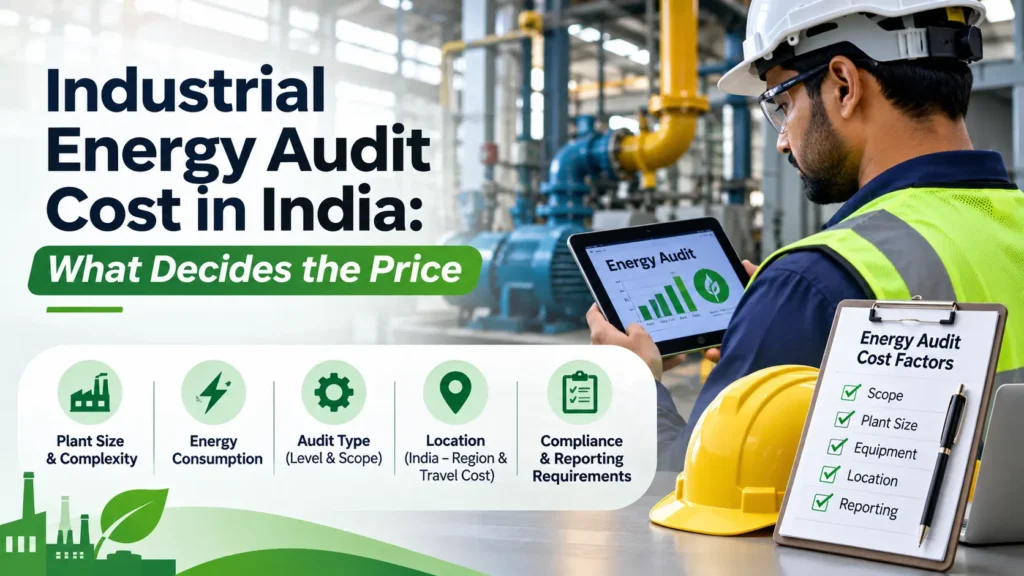
Here are the factors that move an energy audit fee, and what you can do about each one.
Factor | Why it changes the fee | What you can do |
|---|---|---|
Plant size and connected load | More equipment means more to measure and more time on site | Send a clear equipment list up front |
Number of systems covered | Electrical, motors, compressed air, furnaces, boilers, chillers and lighting each need their own measurements | Decide which systems matter most to you |
Depth of audit | Walk-through, detailed and investment-grade need different effort | Ask the auditor to explain the difference for your plant |
Instruments and logging time | Power analysers, thermal cameras, flue gas analysers and leak detectors take time to deploy and read | Ask which instruments will be used |
Days on site and number of visits | Longer measurement periods mean more engineer time | Make the plant available during normal production |
Process complexity | A foundry or forging unit with furnaces is more involved than a simple assembly line | Share your process details early |
Location and travel | Distance adds travel and stay | Group sites together if you have several |
Quality of your data | Missing bills, drawings or logs mean the auditor has to collect more from scratch | Keep 12 months of bills and a single line diagram ready |
Reporting and compliance needs | A statutory report needs more than a management report | Tell the auditor your purpose |
Follow-up support | Help with implementation is often a separate scope | Ask whether it is included or extra |
If your plant uses compressed air, thermal equipment and electrical systems together, the audit will need several instruments and more time. Services such as thermal imaging and electrical safety audits, flue gas analysis and compressed air leak detection can sit inside a larger audit or be done on their own when you only need one part checked.
What an Energy Audit Fee Should Include
Before you compare two quotes, check that they cover the same things. A proper detailed audit fee usually includes:
- site visits and a walk through the plant;
- measurements with the right instruments;
- analysis of your bills and production data;
- an energy balance showing where energy goes;
- quantified savings for each recommendation;
- investment and payback estimates;
- a written report and a presentation to your team.
Some things are often billed separately, so ask about them: help with implementing the recommendations, monitoring after the work is done, and filing for statutory purposes. Our own approach covers benchmarking, cost–benefit analysis and payback estimates, and we offer implementation support as a separate service so you can choose what you need.
Energy Audit Cost in India by State
Does location change the energy audit price? Sometimes, but not as much as people expect. Location matters mainly through travel and through the mix of industries and sites in the area. Your local power tariff doesn’t change the audit fee, but it does change how much you save, which is what really decides whether the audit pays off.
We work across India. If you are searching for the energy audit cost in your state, these pages cover our work there:
- Gujarat: our energy audit services in Gujarat cover plants in Rajkot, Ahmedabad, Gandhidham and Bhavnagar.
- Maharashtra: see energy audit services in Maharashtra for industrial and commercial facilities across the state.
- Rajasthan: energy audit in Rajasthan for manufacturing units and other facilities.
- Uttar Pradesh: energy audit services in Uttar Pradesh for plants and commercial buildings.
- Delhi NCR: energy audit services in Delhi NCR covers Gurgaon, Noida, Faridabad and Manesar, including commercial buildings and auto-component and engineering units.
- Karnataka: energy audit in Karnataka for industrial and commercial sites.
- Telangana: energy audit services in Telangana for factories and other facilities.
- Tamil Nadu: energy audit in Tamil Nadu for industrial and commercial clients.
Not in one of these states? Get in touch anyway. Tell us where the plant is and we will tell you how we can help.
Is a Cheap Energy Audit Worth It?
Sometimes the cheapest quote is fine. Often it isn’t. Watch for these warning signs:
- No instruments. If the report relies on benchmarks instead of measurements at your plant, the savings figures are estimates, and they can be well off.
- A vague scope. “Energy audit” with no list of systems, days on site or deliverables could mean almost anything.
- A seller of equipment doing the audit for “free”. The recommendations may lean toward the products being sold.
- No payback calculation. A report that lists ideas without costs and paybacks is hard to act on.
- No one to talk to afterwards. An audit you can’t get questions answered on is worth less.
A low fee isn’t a problem in itself. A low fee for a thin scope is.
Questions to Ask Before You Accept a Quote
- Which systems and areas of the plant does the audit cover?
- Is it a walk-through, a detailed audit or an investment-grade study?
- Which instruments will you use, and for how long?
- How many days will the team be on site?
- Will the savings be based on measurements or benchmarks?
- What will the report contain, and can I see a sample?
- Are payback and investment estimates included for every recommendation?
- Is help with implementation included or separate?
- Who will lead the audit, and what are their certifications? You can see ours on our certifications page.
How to Judge Whether an Audit Is Worth the Fee
Don’t judge the audit by its price alone. Judge it by what it saves you compared with what it costs.
Audit payback = audit fee ÷ annual savings from the measures you actually implement
The key words are “actually implement”. A report that sits in a drawer saves nothing, however low the fee. That is why implementation matters as much as the audit itself. Our audits typically aim to reduce power and fuel bills by 10–30%, though results depend on your plant and on what gets done. If you want to see how savings are worked out, our guide to energy saving in manufacturing plants is a good place to start.
What to Send Your Auditor to Get an Accurate Quote
The better the information, the closer the quote will be to the final scope. Have these ready:
- 12 months of electricity bills and fuel records;
- connected load and a list of major equipment (motors, compressors, furnaces, boilers, chillers);
- number of shifts and operating hours;
- a short description of the process;
- a single line diagram, if you have one;
- the reason for the audit: cutting costs, compliance, a customer requirement or a planned upgrade;
- the plant location.
With this, a good auditor can tell you which audit level suits you and what it will involve.
Is an Energy Audit Mandatory in India?
Only for some plants. Under the Energy Conservation Act, 2001, industries notified by the Bureau of Energy Efficiency (BEE) as Designated Consumers have audit obligations, with thresholds set sector by sector. If you are one, check the requirements with BEE or your state designated agency, including who is allowed to carry out the audit. Most other plants audit voluntarily, to cut energy costs.
Conclusion
The industrial energy audit cost isn’t one number. It is the result of your plant’s size, systems and the depth of audit you choose. The most useful thing you can do is ask for a clear scope, compare like with like, and judge the audit by the savings it leads to.
If you want a quote built around your plant, contact Optimus Energy Services with your location, equipment and goals, or call +91 98503 66248. We will recommend the audit level that fits and explain exactly what you will get.