

Energy Audit Services in Uttar Pradesh
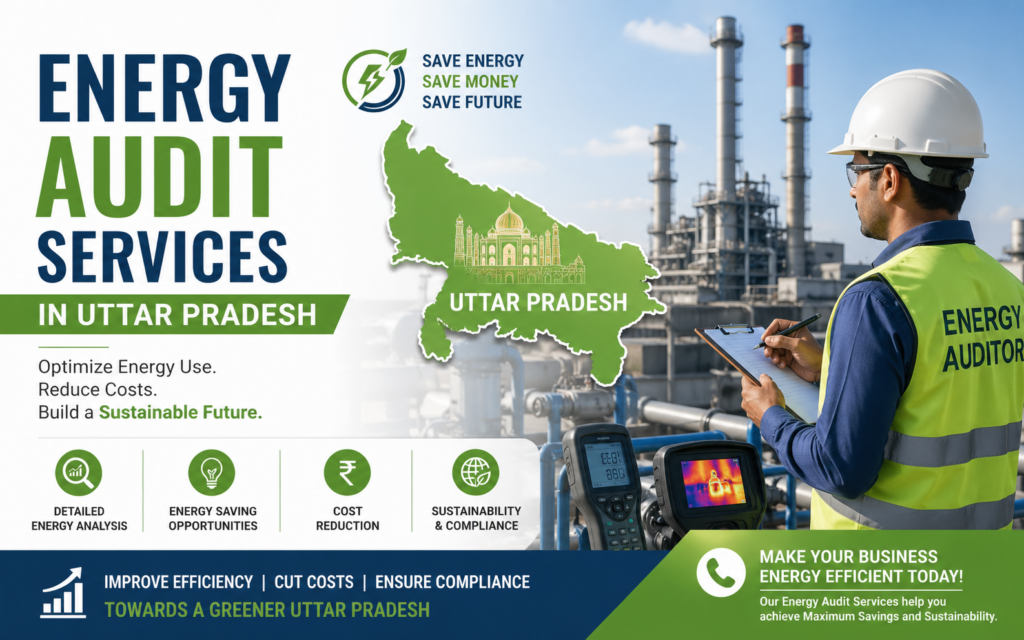
Uttar Pradesh's Industrial Growth and the Energy Efficiency Opportunity
Uttar Pradesh has undergone a significant industrial transformation over the past decade. Noida and Greater Noida have emerged as major IT and electronics manufacturing hubs. Kanpur's leather and textile industries continue to be significant energy consumers. Agra's food processing and tourism-related commercial infrastructure is expanding. Varanasi, Lucknow, and Meerut each have their own manufacturing and commercial energy profiles.
UPPCL's electricity tariffs, combined with frequent voltage fluctuations in industrial areas, create a challenging operating environment. For factories in UP's manufacturing zones, power quality issues and inadequate power factor correction often contribute 10–20% to electricity bills unnecessarily. For commercial establishments in Lucknow and Noida, HVAC inefficiency and poor lighting energy management are the primary drivers of excess consumption.
Industrial energy audit services in Uttar Pradesh are addressing a genuine and growing need. Whether it's a leather goods manufacturer in Kanpur, a garment unit in Noida, a food processing plant in Agra, or a hospital complex in Lucknow, there is almost always significant, recoverable energy waste waiting to be found and fixed.
What Is an Energy Audit?
An energy audit is a systematic, professional examination of how energy is used across a facility — covering electrical systems, thermal equipment, compressed air, HVAC, and process energy — to identify where energy is wasted and what can practically be done about it.
The Bureau of Energy Efficiency (BEE) under India's Ministry of Power governs energy auditing standards nationally. BEE-certified energy auditors are trained, examined, and accredited to produce audit reports that meet regulatory requirements. For Designated Consumers in UP's industrial sector, BEE-accredited audits are not optional — they are a legal requirement under the Energy Conservation Act, 2001.
Why Energy Audits Matter Particularly in Uttar Pradesh
UP's industrial sector spans an unusually wide range of energy intensity levels. Kanpur's leather tanneries and textile mills are energy-intensive operations where steam efficiency, compressed air management, and thermal insulation are the primary levers. Noida's electronics and garment manufacturers have different profiles — dominated by electrical loads, HVAC, and compressed air.
The state's power infrastructure challenges — including load shedding in some zones and voltage instability — mean that many facilities run diesel generators as a backup or supplementary source, adding further cost complexity. A good energy audit accounts for this mixed supply reality and looks at generator efficiency, load management, and opportunities to reduce dependence on expensive backup power.
What we've observed across UP's manufacturing belt is that many SMEs have never had a structured energy review. They've absorbed rising tariff costs as an unavoidable expense rather than examining what portion of that cost is actually recoverable. The reality is that even a basic electrical audit and compressed air system check can identify savings that pay back within one to two billing cycles.
Types of Energy Audit Services We Offer
Electrical Energy Audit
Comprehensive review of electrical distribution, power factor, harmonic distortion, maximum demand management, motor efficiency, and individual load categories. Power factor correction alone, in many UP industrial facilities, can eliminate demand penalties worth Rs. 2–8 lakh annually.
Thermal Imaging Inspection
Infrared thermography of electrical panels, transformers, motors, and process equipment surfaces. Thermal imaging inspections in UP's manufacturing facilities frequently identify overheating connections and failing equipment that present both safety and efficiency concerns.
Thermal Energy Audit
For facilities with boilers, furnaces, thermic fluid heaters, or steam distribution systems — common in Kanpur's textile and leather sector — the thermal audit identifies losses in combustion, steam trapping, piping insulation, and heat recovery.
Flue Gas Analysis
Measurement and analysis of combustion gases from boilers and industrial heating equipment. Small improvements in combustion efficiency based on flue gas data can reduce fuel consumption by 4–8% with minimal capital investment.
Compressed Air System Audit
Ultrasonic detection of compressed air leaks across the distribution network, quantification of leakage volume and cost, and recommendations for pressure optimisation. In UP's manufacturing sector, we routinely find 20–35% of compressed air is lost to leaks.
Walk-Through and Detailed Audits
Scalable from a rapid walk-through for smaller facilities to a full investment-grade detailed audit for large DCs requiring comprehensive financial modelling of energy improvements.
Our Energy Audit Process
- Site Inspection: Our certified engineers visit the facility, walk all energy-consuming areas, and develop a comprehensive picture of the energy systems and operating context.
- Data Collection: Utility bill analysis, equipment data, and real-time instrumentation on critical systems to capture accurate load profiles and performance data.
- Energy Analysis: Data is benchmarked against industry norms. Primary inefficiencies are identified and quantified with savings potential estimated for each.
- Audit Report with ROI Insights: Written report with specific findings, prioritised recommendations, estimated annual savings, implementation investment, and payback periods.
- Implementation Guidance: Post-audit support for technical specification, vendor evaluation, and savings verification following implementation.
Industries We Serve in Uttar Pradesh
Our energy audit work in UP covers leather manufacturers and tanneries in Kanpur, garment and textile units in Noida and Greater Noida, food processing and cold storage facilities in Agra and Mathura, engineering and auto components manufacturers across Lucknow and Ghaziabad, and pharmaceutical units in Lucknow and Noida.
We also audit commercial buildings, hospitals, educational institutions, and large residential complexes in Lucknow, Varanasi, and Agra, where HVAC and common area energy management are the primary focus.
Practical Benefits You Can Expect
Industrial facilities in UP implementing energy audit recommendations typically see 12–25% reduction in energy costs within 12 months. For a Kanpur textile mill with a monthly electricity bill of Rs. 15–30 lakh, this translates to Rs. 2–7.5 lakh in monthly savings. Compressed air and electrical corrections often deliver savings within the first billing cycle. Thermal improvements take longer to implement but deliver sustained results over years.
Energy Audit Compliance in India
Uttar Pradesh's large industrial consumers — particularly in textiles, leather, chemicals, and food processing — fall under BEE's Designated Consumer framework. Periodic energy audits by BEE-accredited auditors are mandatory for these facilities. The PAT scheme assigns energy intensity reduction targets to large DCs, with financial penalties for underperformance.
Our BEE-certified auditors produce audit reports that satisfy all statutory requirements under the Energy Conservation Act, including documentation suitable for BEE's annual data submission requirements.
Cities We Serve in Uttar Pradesh
We provide energy audit services across Lucknow, Noida, Greater Noida, Kanpur, Agra, Varanasi, Meerut, Ghaziabad, Allahabad (Prayagraj), Mathura, Bareilly, Aligarh, Moradabad, and industrial estates across UPSIDC zones in Uttar Pradesh.
Cost of Energy Audit in Uttar Pradesh
The cost of an energy audit in Uttar Pradesh varies by facility size and audit depth. Walk-through audits for SME manufacturing units start from approximately Rs. 12,000–28,000. Detailed industrial audits for mid-size facilities typically range from Rs. 45,000 to Rs. 1,80,000. For large DCs requiring comprehensive instrumented assessments, costs may range from Rs. 2,00,000 to Rs. 6,00,000.
For most UP industrial clients, the savings identified in the audit pay back the cost within the first month or two of implementation.
Why Choose Us
We have practical experience across UP's diverse industrial sectors — from high-temperature leather processing in Kanpur to precision electronics assembly in Noida. Our BEE-certified auditors understand the operational realities of UP's manufacturing environment, including power quality challenges, mixed grid and DG supply management, and the specific energy profiles of the state's key industries.
Our reports are built to be used — specific, implementable, and financially justified. We don't produce assessments that sit in a drawer. We produce findings that management can act on with confidence.
Frequently Asked Questions
-
What are energy audit services in Noida for manufacturing units?In Noida, our energy audit services for manufacturing units cover electrical system analysis, compressed air leak detection, thermal imaging inspection, and detailed energy mapping across production equipment. We serve electronics manufacturers, garment and textile units, pharma facilities, and auto component manufacturers.
-
Is industrial energy audit mandatory in Uttar Pradesh?Yes, for industrial facilities classified as Designated Consumers under BEE's framework — including those in textiles, chemicals, leather, and food processing above specified energy thresholds — periodic energy audits by BEE-certified auditors are mandatory.
-
What does an industrial energy audit in Kanpur involve?A Kanpur industrial energy audit typically covers steam systems and boiler efficiency, compressed air management, electrical power factor and distribution losses, motor efficiency, and thermal insulation assessment. Given the textile and leather sector's energy profile, thermal audits tend to offer the highest individual savings opportunity.
-
What is the cost of an energy audit in UP?For a mid-size factory, a detailed energy audit in UP typically costs Rs. 45,000–1,50,000 depending on plant size and systems involved. Savings identified commonly run to several lakh rupees annually, making the payback period on the audit itself very short.
-
How do I find a certified energy auditor in Uttar Pradesh?BEE-accredited certified energy auditors can be engaged through firms like ours that maintain qualified audit teams. Our UP-based auditors hold valid BEE certification and have direct manufacturing sector experience across the state's major industrial zones. Contact us for an initial consultation.