

Energy Audit Services in Tamil Nadu
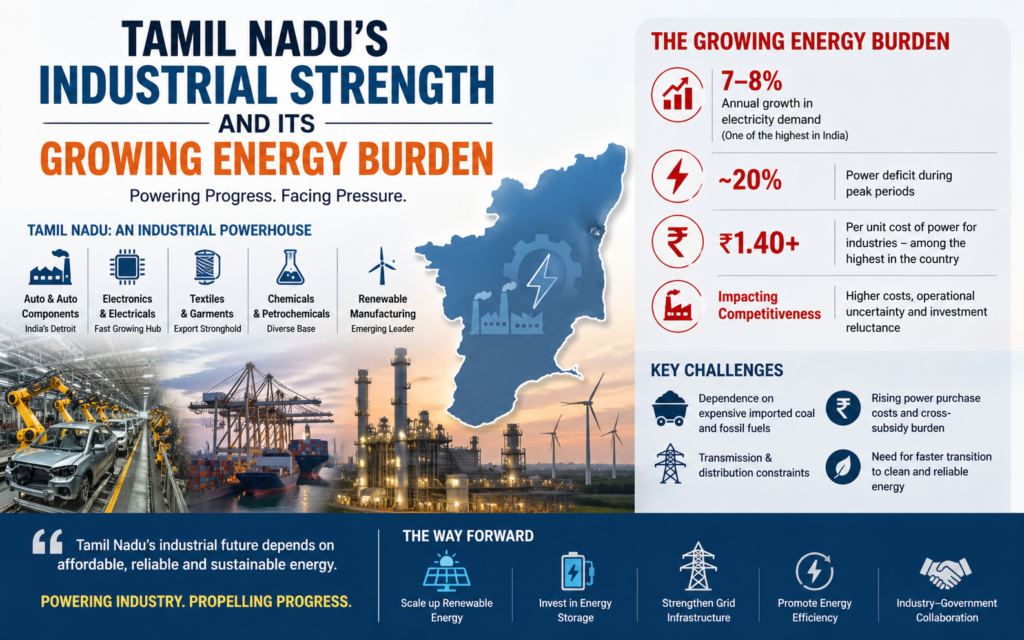
Tamil Nadu's Industrial Strength and Its Growing Energy Burden
Tamil Nadu occupies a unique position in India's industrial geography. It is simultaneously one of the country's largest textile producers, a major auto manufacturing hub, a significant pharmaceuticals and chemicals base, and a rapidly growing information technology corridor. The state's industrial zones — from the Tiruppur hosiery cluster and the Coimbatore engineering belt to Chennai's auto and pharma corridor and Hosur's electronics manufacturing zone — collectively consume massive quantities of electrical and thermal energy every day.
TANGEDCO's tariff structure, while not the country's highest, has seen consistent revisions upward over recent years. For high-load industries running multiple shifts, electricity is often the single largest operating cost after raw materials. What makes this especially frustrating is that a significant portion of that spend is unnecessary — attributable to equipment inefficiency, poor power factor, steam losses, compressed air leaks, and other entirely solvable problems.
Industrial energy audit services in Tamil Nadu have become an essential tool for plant managers, finance heads, and sustainability officers who are serious about keeping operations competitive. Whether you're running a spinning mill in Tiruppur, an auto components plant in Chennai, or a pharmaceutical facility in Hosur, a professional energy audit is where meaningful cost reduction starts.
What Is an Energy Audit?
An energy audit is a structured, evidence-based examination of how energy enters, moves through, and exits a facility — and where value is lost along the way. It draws on measurements, data analysis, equipment inspection, and industry benchmarks to produce a clear, prioritised picture of where efficiency improvements are possible.
In India, the Bureau of Energy Efficiency (BEE) under the Ministry of Power governs the practice of energy auditing. BEE-certified auditors are qualified to produce statutory audit reports for Designated Consumers under the Energy Conservation Act, 2001. Engaging a BEE-accredited auditor ensures that findings are rigorous, credible, and compliant with regulatory expectations — important both for compliance purposes and for using the report to justify capital investments to banks or boards.
Why Energy Audits Are Especially Valuable in Tamil Nadu
Tamil Nadu's textile industry — spanning ginning, spinning, weaving, knitting, dyeing, and garment manufacturing — is one of the most energy-intensive sectors in the country. Compressed air is used extensively across these operations, and in most facilities, a significant percentage of compressed air generated never reaches the point of use. Our compressed air leak detection service has identified leakage rates of 25–40% in spinning and weaving units — each percentage point representing recoverable annual savings.
The thermal energy intensity of Tamil Nadu's dyeing and processing sector is also substantial. Boiler and thermic fluid heater efficiency, steam trap performance, and heat recovery from process effluents are all areas where a thermal energy audit consistently uncovers meaningful opportunities. Flue gas analysis in these settings routinely reveals combustion inefficiencies that can be corrected with relatively simple adjustments.
For Chennai's growing commercial and IT corridor, HVAC systems and data centre cooling represent the primary energy focus. And across the state's pharmaceutical, chemicals, and food processing sectors, there are unique thermal and process energy challenges that require auditors with genuine sector experience — not generic checklists.
Types of Energy Audit Services We Offer
Electrical Energy Audit
A comprehensive review of electrical systems from the incoming supply to individual equipment loads. We assess power factor, harmonic distortion, maximum demand management, distribution losses, and motor efficiency — producing a detailed consumption breakdown and prioritised list of electrical energy savings opportunities.
Thermal Imaging Inspection
Using infrared thermography, we scan electrical panels, switchgear, motors, transformers, and industrial process equipment for thermal anomalies — hotspots, insulation failures, and overheating components that signal both inefficiency and safety risk. In Tamil Nadu's textile and auto plants, thermal imaging inspections have repeatedly caught serious electrical failures in early stages.
Thermal Energy Audit
For facilities with boilers, thermic fluid heaters, steam networks, and process heating equipment, the thermal audit is often where the most significant savings are found. We assess combustion efficiency, steam trap performance, insulation quality, heat exchanger effectiveness, and waste heat recovery potential.
Flue Gas Analysis
Measurement of combustion gases (O2, CO2, CO, and flue temperature) from boilers and industrial furnaces. Small corrections to excess air levels based on flue gas data can improve combustion efficiency by 4–8%, with direct and immediate impact on fuel costs.
Compressed Air System Audit
Using ultrasonic leak detection equipment, we map and quantify compressed air losses across the distribution network. This is among the most consistently high-ROI services we provide — Tamil Nadu's textile industry in particular sees enormous savings from compressed air optimisation.
Walk-Through and Detailed Audits
From a rapid preliminary assessment suitable for smaller facilities to a full investment-grade audit for large DCs, we calibrate the depth of the study to your specific needs and objectives.
Our Energy Audit Process
- Site Inspection: Our certified engineers visit the facility, walk every section, and document all major energy-consuming systems, production processes, and operational patterns.
- Data Collection: We review utility bills, equipment records, and production data, and deploy instruments to capture real-time load profiles and thermal measurements.
- Energy Analysis: Collected data is processed against sector benchmarks. We identify the primary energy end-uses, key inefficiencies, and the improvement measures with the greatest financial impact.
- Audit Report with ROI Insights: A detailed written report with specific findings, prioritised recommendations, projected annual savings, implementation costs, and simple payback periods.
- Implementation Guidance: Post-report technical support — including vendor evaluation, equipment specifications, and follow-up verification of savings achieved.
Industries We Serve in Tamil Nadu
Our energy audit experience in Tamil Nadu spans the textile industry across Tiruppur, Coimbatore, Erode, and Salem — covering spinning mills, dyeing units, knitting facilities, and composite textile plants. We serve the automotive and auto components sector in Chennai, Sriperumbudur, and Hosur, with specific expertise in press shops, paint lines, and assembly facilities.
Pharmaceutical manufacturers and API producers in Chennai and Hosur have benefited from our thermal and process energy audit work. Food processing units in Madurai, Trichy, and Salem require customised approaches given their refrigeration and process heating profiles. We also audit chemical plants, foundries, engineering goods manufacturers, commercial buildings, and large hospitality properties across the state.
Practical Benefits You Can Expect
Tamil Nadu's textile units that have implemented energy audit recommendations have consistently achieved 12–22% reduction in specific energy consumption. For a spinning mill with a monthly electricity bill of Rs. 30–50 lakh, that translates to Rs. 3.5–11 lakh in monthly savings — far exceeding the audit cost within weeks. For thermal-intensive industries, boiler efficiency improvements and steam loss reduction commonly add another Rs. 5–20 lakh annually.
Beyond cost: reduced downtime from early detection of electrical and mechanical issues through thermal imaging, improved power quality reducing equipment failures, and documented energy performance data for sustainability and export compliance requirements.
Energy Audit Compliance in India
The Energy Conservation Act mandates periodic energy audits for Designated Consumers — industrial and commercial facilities above defined energy consumption thresholds in sectors including textiles, chemicals, pharmaceuticals, food processing, and large commercial buildings. Tamil Nadu has a large number of DCs, and BEE compliance is actively monitored.
The PAT scheme further requires large DCs to meet specific energy intensity targets, with financial consequences for underperformance. Our BEE-accredited audit reports provide the documented evidence of energy performance and improvement measures that regulatory submissions require.
Cities We Serve in Tamil Nadu
We provide energy audit services across Chennai, Coimbatore, Madurai, Tiruchirappalli, Salem, Tiruppur, Vellore, Erode, Tirunelveli, Thoothukudi, Hosur, Dindigul, Karur, Namakkal, and industrial zones across SIPCOT estates and TIDCO parks throughout Tamil Nadu.
Cost of Energy Audit in Tamil Nadu
The cost of an energy audit in Tamil Nadu depends on facility size, sector, and audit scope. Walk-through audits for SME manufacturing units start from approximately Rs. 15,000–35,000. Detailed audits for mid-size textile or auto component facilities typically range from Rs. 60,000 to Rs. 2,50,000. Large industrial facilities requiring multi-day instrumented studies may see costs in the Rs. 2,50,000–8,00,000 range.
For most facilities, the identified savings recover the audit cost within the first 4–8 weeks of implementation. The economics are particularly compelling for energy-intensive textile and process industries where the absolute energy spend is high.
Why Choose Us
Our team has deep, practical experience across Tamil Nadu's most energy-intensive sectors. Our BEE-certified energy auditors are not generalists — they bring specific sector knowledge of textile energy systems, automotive process energy, and pharmaceutical thermal requirements. We understand the operational realities of running a spinning mill across three shifts or managing a pharmaceutical clean room's HVAC demands.
Every audit report we produce is built around what's actually achievable in your specific facility — not theoretical benchmarks. We provide implementation-ready findings with realistic savings projections based on measured data, not assumptions.
Frequently Asked Questions
-
What are the energy audit services available in Chennai?In Chennai, we provide electrical energy audits, thermal imaging inspections, compressed air leak detection, flue gas analysis, HVAC audits for commercial buildings, and detailed investment-grade audits for industrial facilities. We serve auto and pharma manufacturers, IT campuses, hospitals, hotels, and commercial buildings.
-
How does an energy audit benefit textile industries in Tamil Nadu?For textile units, energy audits typically identify savings across compressed air systems (25–40% leakage reduction), motor efficiency improvements, power factor correction, boiler and thermic fluid heater optimisation, and lighting upgrades. Combined savings of 15–25% on total energy spend are commonly achieved by Tiruppur and Coimbatore textile units following a detailed audit.
-
What is the cost of an energy audit in Tamil Nadu?For a mid-size textile unit, a detailed energy audit costs approximately Rs. 60,000–1,80,000. For auto components plants and pharmaceutical facilities, the range is typically Rs. 80,000–3,00,000 depending on plant size and complexity. The audit investment is almost always recovered within the first two months of implementing recommendations.
-
Is energy audit mandatory for textile companies in Tamil Nadu?Yes, textile units above BEE's Designated Consumer threshold are mandated to conduct periodic energy audits by BEE-certified auditors. Additionally, many export-oriented textile businesses face sustainability requirements from international buyers that effectively make energy auditing a commercial necessity even for facilities below the statutory threshold.
-
Who is a certified energy auditor in Chennai?A certified energy auditor is a BEE-accredited professional qualified under the Energy Conservation Act to conduct statutory energy audits and sign audit reports for Designated Consumers. Our Chennai-based auditors hold valid BEE certification and have hands-on experience across the city's industrial and commercial sectors.
-
How long does an energy audit take for a spinning mill?A detailed energy audit for a spinning mill typically takes 4–8 working days — including site visits for measurements, data collection, and report preparation. The timeline depends on mill size and the number of systems to be assessed. Walk-through audits can be completed in 1–2 days.