

Energy Audit Services in Gujarat
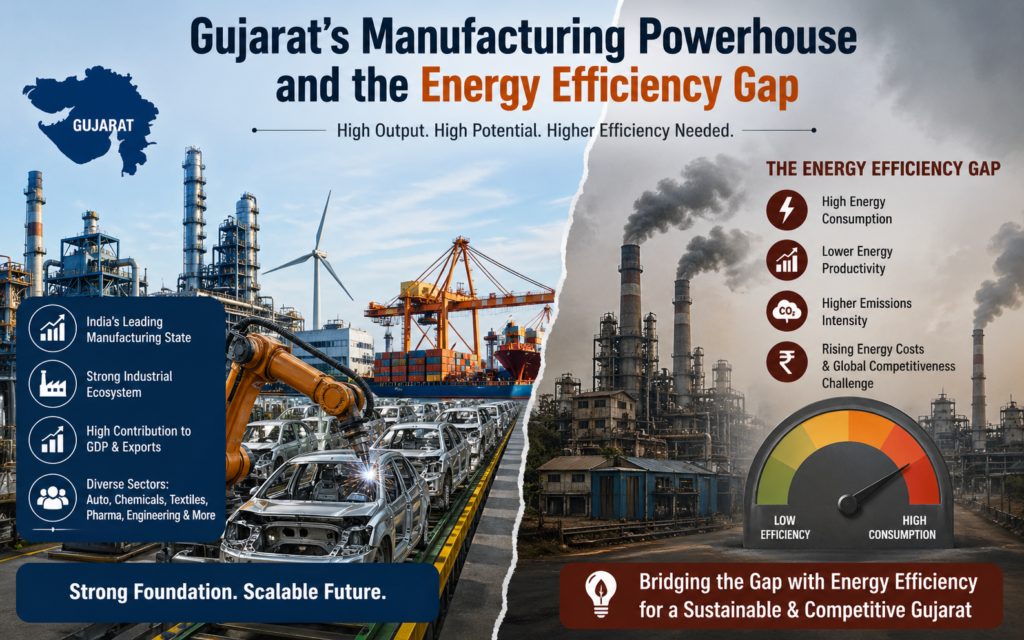
Gujarat's Manufacturing Powerhouse and the Energy Efficiency Gap
Gujarat is arguably India's most industrialised state. From the massive chemical and petrochemical clusters in Surat and Ankleshwar to the world-renowned textile belt spanning Ahmedabad, Surat, and Rajkot, the state's manufacturing output is staggering — and so is its electricity consumption. Gujarat Industrial Development Corporation (GIDC) estates house thousands of SMEs and large industrial units, many of which have been running the same equipment and processes for a decade or more without any structured review of energy performance.
The sheer diversity of industries — ceramics in Morbi, pharmaceuticals in Vadodara and Ankleshwar, auto parts in Rajkot, engineering in Bhavnagar, and diamond processing in Surat — means that energy consumption patterns are highly varied. Gujarat Urja Vikas Nigam Limited (GUVNL) tariff structures, combined with peak-hour surcharges and maximum demand penalties, mean that even mid-size units face electricity bills that are routinely 20–30% higher than they need to be.
Industrial energy audit services in Gujarat have never been more relevant. With rising input costs squeezing margins across the manufacturing sector, energy is increasingly the lever that separates competitive factories from struggling ones.
What Is an Energy Audit?
An energy audit is a systematic, technical evaluation of how energy flows through a facility — and where it's being lost or wasted. Rather than guesswork, it relies on measurement, analysis, and benchmarking to produce actionable findings.
In India, energy audits are governed under the Bureau of Energy Efficiency (BEE), established under the Energy Conservation Act, 2001. BEE certifies qualified energy auditors and mandates periodic audits for Designated Consumers in energy-intensive sectors. A BEE-accredited audit report is the standard expected by regulatory bodies and is increasingly demanded by banks, investors, and large buyers as part of due diligence.
In reality, an energy audit is less about compliance and more about the straightforward business case: spend a small amount on assessment, recover multiples of that in reduced energy costs every year going forward.
Why Energy Audits Are Critical for Gujarat Industries
Gujarat's textile sector is one of the country's largest consumers of both electrical and thermal energy. Spinning mills, weaving units, processing houses, and dyeing facilities consume enormous quantities of power — and a significant portion of that is wasted in steam distribution losses, compressor inefficiencies, and aging motor systems running well below nameplate efficiency.
The ceramics industry in Morbi is similarly energy-intensive, relying heavily on high-temperature kiln operations where fuel efficiency has a direct and immediate impact on production cost. Flue gas analysis in these settings routinely reveals combustion inefficiencies that represent 5–12% of total fuel spend — recoverable with relatively straightforward adjustments.
For the chemical and pharma clusters in Ankleshwar and Vadodara, thermal energy audit work covering steam systems, heat exchangers, and distillation equipment is often where the most significant savings lie. And across virtually every sector, compressed air system leaks represent a quietly enormous waste — one that ultrasonic leak detection can map and quantify in hours.
Types of Energy Audit Services We Offer
Electrical Energy Audit
A comprehensive review of the electrical infrastructure — distribution boards, transformers, capacitor banks, drives, and machine loads. We identify power quality issues, demand spikes, poor power factor, and equipment operating outside optimal parameters.
Thermal Imaging Inspection
Using high-resolution infrared cameras, our engineers scan electrical switchgear, motors, cables, and refractory surfaces for thermal anomalies. In Gujarat's ceramic and chemical plants, thermal imaging inspections have repeatedly identified kiln insulation degradation and panel overheating that were costing money silently for months.
Flue Gas Analysis
For boilers, furnaces, and combustion equipment used extensively in textile processing, ceramics, and chemical manufacturing, flue gas analysis pinpoints combustion inefficiency with measured data. Small corrections in air-to-fuel ratios often deliver 4–8% improvement in thermal efficiency.
Compressed Air Leak Detection
Using professional ultrasonic leak detectors, we survey compressed air pipelines across the facility, map leak locations, estimate leakage volume, and quantify the associated energy cost. In most Gujarat manufacturing plants we've audited, this single exercise identifies Rs. 3–12 lakh in recoverable annual savings.
Walk-Through and Detailed Audits
From rapid preliminary assessments to full investment-grade audits with financial modelling, we tailor the depth of analysis to your specific need — whether that's a quick energy health-check or a comprehensive study to support a capital investment decision.
Our Energy Audit Process
- Site Inspection: Our certified team visits the facility, documents all major energy-consuming systems, and develops a clear understanding of operational patterns and process flows.
- Data Collection: We analyse 12 months of utility bills, collect equipment data, and where required, deploy instruments for real-time load and thermal monitoring.
- Energy Analysis: Data is processed against industry benchmarks. We map energy flows, identify the largest sources of inefficiency, and quantify improvement potential.
- Audit Report with ROI Insights: A detailed written report covering findings, prioritised recommendations, projected savings, and investment payback periods. Every recommendation is backed by measured data.
- Implementation Guidance: Post-audit support for vendor evaluation, specification of recommended equipment, and verification of savings achieved after implementation.
Industries We Serve in Gujarat
Our energy audit work in Gujarat spans the textile industry in Ahmedabad, Surat, and Rajkot — including spinning, weaving, and dyeing units. We serve the ceramics manufacturers in Morbi with specialised thermal and kiln audit services. Pharmaceutical and API manufacturers in Ankleshwar and Vadodara benefit from our steam system and process heating audits. Chemical plants along the Dahej and Nandesari corridors require careful hazardous-zone-compliant audit approaches that our team is trained for.
We also serve engineering goods manufacturers in Rajkot and Jamnagar, power saving solutions for commercial complexes and malls in Ahmedabad, food processing units, and glass manufacturers requiring detailed thermal profiling.
Practical Benefits You Can Expect
Energy audit clients in Gujarat's textile sector have consistently achieved 15–25% reduction in specific energy consumption following implementation of audit recommendations. For ceramic plant operators, combustion efficiency improvements alone have translated to Rs. 15–40 lakh in annual savings per kiln. Across industrial facilities of all types, compressed air optimisation and electrical corrections tend to deliver the fastest payback — often under six months.
Beyond direct savings: reduced equipment failure rates, improved power quality, lower carbon intensity for export-facing businesses under international supply chain requirements, and documented BEE compliance.
Energy Audit Compliance in India
The Energy Conservation Act, 2001 mandates that Designated Consumers — large industrial and commercial energy users in specified sectors — conduct energy audits by BEE-accredited auditors at prescribed intervals. Gujarat has a high concentration of DCs in the textile, chemical, ceramics, and pharma sectors.
Under the PAT (Perform, Achieve and Trade) scheme, DCs are assigned specific energy intensity reduction targets. Facilities that miss targets must purchase ESCerts — a cost that an effective audit and implementation programme easily avoids. Our audit reports are fully compliant with BEE documentation requirements.
Cities We Serve in Gujarat
We provide energy audit services in Ahmedabad, Surat, Vadodara, Rajkot, Gandhinagar, Ankleshwar, Morbi, Bharuch, Jamnagar, Bhavnagar, Mehsana, Nadiad, Anand, Junagadh, and industrial estates across the GIDC network.
Cost of Energy Audit in Gujarat
The cost of an energy audit in Gujarat depends on facility size, energy systems involved, and audit depth. Walk-through audits for SME units start from approximately Rs. 12,000–30,000. Detailed audits for medium industrial facilities typically range from Rs. 40,000 to Rs. 2,00,000. For large plants in the textile or chemical sector requiring multi-day instrumented studies, costs can range from Rs. 2,50,000 to Rs. 8,00,000. Given that identified savings routinely run to several lakh rupees annually, the return on audit investment is typically measured in weeks to months.
Why Choose Us
Our team has conducted energy audits across Gujarat's most demanding industrial environments — including ATEX-rated zones in chemical plants, 24x7 process facilities in pharma, and high-temperature environments in ceramics and glass. Our BEE-certified auditors bring not just credentials but genuine industry experience.
We produce reports that plant managers and engineers actually use. Not generic templates — specific findings, plant-specific savings estimates, and practical implementation roadmaps. Our track record across certified energy auditor work for Gujarat industries speaks for itself in the measurable outcomes our clients achieve.
Frequently Asked Questions
-
What are the energy audit services available in Ahmedabad?In Ahmedabad, we offer the full range of audit services — electrical energy audit, thermal imaging inspection, compressed air leak detection, flue gas analysis, and detailed investment-grade audits. We serve commercial buildings, textile mills, pharmaceutical units, food processing plants, and large commercial complexes.
-
What does a certified energy auditor in Gujarat do?A certified energy auditor (BEE-accredited) conducts a systematic assessment of a facility's energy consumption, identifies inefficiencies, and produces a report with quantified savings recommendations. They are also qualified to sign statutory audit reports required for Designated Consumers under the Energy Conservation Act.
-
What is the cost of an energy audit in Gujarat for a textile mill?For a mid-size textile unit, a detailed energy audit covering electrical systems, compressed air, steam, and motor loads typically ranges from Rs. 60,000 to Rs. 2,00,000 depending on plant size and scope. Savings identified commonly range from Rs. 20–80 lakh annually, making the ROI on the audit itself very high.
-
Is energy audit mandatory for industries in Gujarat?Yes, for industries classified as Designated Consumers under BEE's framework — including textile, chemical, ceramics, and pharmaceutical sectors beyond specified energy thresholds — periodic energy audits by BEE-certified auditors are mandatory.
-
Do you conduct energy audits for textile industries in Gujarat?Yes. Textile energy audits are a core part of our Gujarat practice. We cover spinning mills, weaving units, dyeing and processing houses, and composite textile facilities — with specialised expertise in compressed air systems, steam distribution, waste heat recovery, and process heating efficiency.
-
How quickly can energy savings be realised after an audit?Some measures — compressed air leak sealing, power factor correction, and lighting upgrades — deliver savings almost immediately. Process and equipment changes take 3–12 months to implement. Most clients see measurable bill reductions within the first quarter following an audit.