

Energy Audit Services in Karnataka
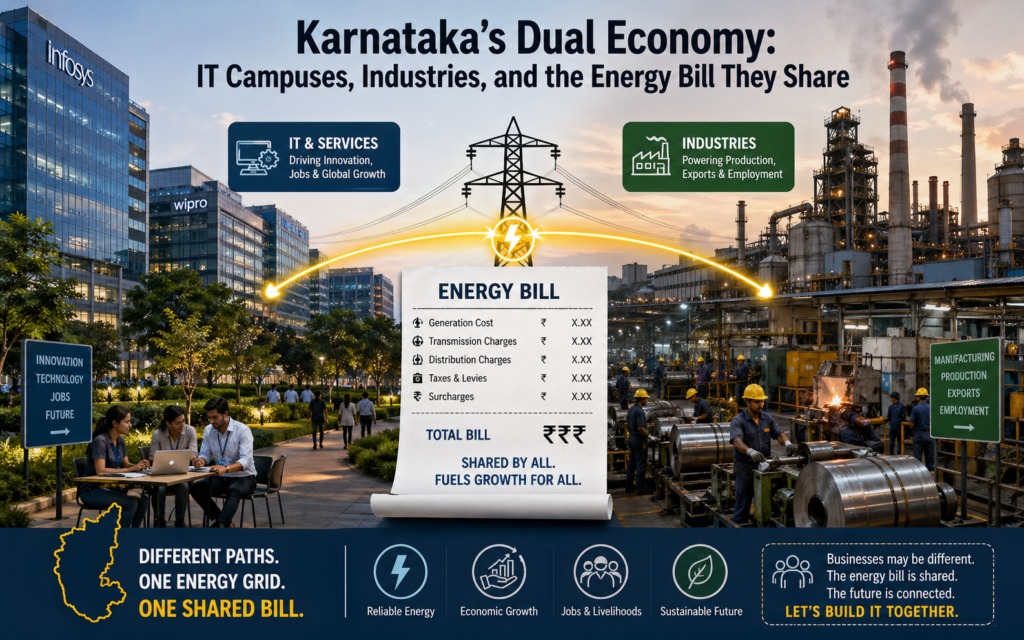
Karnataka's Dual Economy: IT Campuses, Industries, and the Energy Bill They Share
Karnataka presents a fascinating and somewhat unique energy challenge in the Indian context. On one side, you have Bangalore — a city where energy consumption is dominated by air-conditioned IT parks, data centres, hospitals, commercial malls, and a hospitality sector that runs around the clock. On the other side, Karnataka has significant industrial activity: steel plants in Bellary, pharmaceutical manufacturing in Mysuru, cement production in Gulbarga, and textile units across the northern districts.
For commercial buildings, HVAC systems typically account for 45–60% of total electricity consumption — and in most cases, those systems are significantly underoptimised. For industrial facilities, the issues are more diverse but equally impactful: compressed air losses, motor inefficiencies, poor power factor management, and aging steam distribution networks all contribute to electricity bills that are higher than they need to be.
Energy audit services in Karnataka are seeing increasing demand, and understandably so. Between rising BESCOM tariffs, growing sustainability reporting requirements from global IT clients, and tightening BEE compliance norms, both commercial and industrial operators in the state have strong financial and regulatory reasons to get serious about energy efficiency.
What Is an Energy Audit?
An energy audit is a professional, data-driven assessment of how energy is used within a facility — and crucially, where it is wasted. The process involves measurement, observation, analysis, and ultimately a prioritised set of recommendations designed to reduce consumption without affecting operational performance.
India's Bureau of Energy Efficiency (BEE) sets the standards for energy auditing practice in the country. BEE-certified energy auditors undergo rigorous examination and are the only professionals authorised to produce statutory audit reports for Designated Consumers. For commercial and industrial energy users in Karnataka, engaging a BEE-accredited auditor ensures that findings are credible, defensible, and compliant with regulatory expectations.
For most industries, the value of an audit goes well beyond compliance. A quality audit is an investment that pays back — typically many times over — within the first year of implementation.
Why Energy Efficiency Matters in Karnataka's Context
Bangalore's IT park ecosystem is one of the largest concentrations of air-conditioned commercial floor space in Asia. The energy intensity of these buildings — measured in kWh per square metre per year — is frequently 30–50% higher than international benchmarks for similar climates. HVAC audit services are in consistent demand here, and rightly so: optimising chiller plant operations, correcting building envelope deficiencies, and improving BMS control logic can each contribute 10–20% savings on HVAC energy alone.
Karnataka's industrial sector faces different but equally significant challenges. Steel and cement plants in the northern districts are energy-intensive by nature, and even marginal efficiency improvements translate to crore-level savings. Pharmaceutical manufacturers in Mysuru and electronics manufacturers on the outskirts of Bangalore have complex energy profiles that reward detailed audit work.
What we've observed is that Karnataka's commercial sector, in particular, has been slow to conduct systematic energy audits. Building owners focus on LEED or IGBC ratings during construction but rarely follow up with operational energy assessments post-commissioning — which is exactly when real inefficiencies emerge.
Types of Energy Audit Services We Offer
Commercial Building Energy Audit
Our building energy audits cover the full scope of commercial energy systems: HVAC (chiller plants, AHUs, FCUs), lighting, building management systems, elevators and escalators, and server room cooling. We benchmark performance against ASHRAE and NBC standards and identify where energy intensity can be reduced.
Electrical Energy Audit
A detailed review of the electrical system — from incoming supply through distribution to individual equipment loads. This includes power quality analysis, harmonic surveys, capacitor bank performance, and maximum demand management. For large IT campuses and industrial facilities, this work often identifies significant recoverable losses in the electrical distribution chain.
Thermal Imaging Inspection
Infrared thermography is used to identify overheating components in electrical switchgear and distribution systems, as well as thermal anomalies in building envelopes, HVAC ductwork, and industrial process equipment. In Bangalore's dense commercial buildings, thermal imaging inspections regularly find failing circuit breakers, loose connections, and insulation failures that present both safety and efficiency risks.
HVAC Audit Services
Given the climate and commercial density of Bangalore, HVAC systems deserve their own dedicated audit approach. We assess chiller efficiency (kW/TR), cooling tower performance, AHU filter pressure drops, occupancy-based control logic, and refrigerant charge levels — across all of which we routinely find significant optimisation opportunities.
Flue Gas Analysis
For industrial facilities with boilers, process heaters, or DG sets, our flue gas analysis service quantifies combustion efficiency and identifies opportunities to reduce fuel consumption. Even moderate improvements in excess air management can yield 4–6% efficiency gains.
Compressed Air System Audit
Using ultrasonic detection equipment, we locate compressed air leaks across the distribution network and quantify the energy and cost implications. In Karnataka's pharmaceutical and electronics manufacturing facilities, compressed air audits have repeatedly identified 20–40% leakage rates — all recoverable.
Our Energy Audit Process
- Site Inspection: Our engineers walk the entire facility, document energy-consuming systems, and understand the operational context — shift patterns, occupancy, process requirements.
- Data Collection: We gather utility bills, equipment specifications, BMS logs (where available), and deploy instrumentation to capture real-time consumption data on key systems.
- Energy Analysis: Data is analysed against relevant benchmarks. We identify the highest-impact inefficiencies and quantify savings potential for each.
- Audit Report with ROI Insights: A comprehensive written report covering all findings, prioritised recommendations, savings estimates, investment requirements, and payback periods.
- Implementation Guidance: Post-report support to help translate findings into action — including technical specifications, vendor recommendations, and follow-up energy monitoring.
Industries and Sectors We Serve in Karnataka
Our energy audit work in Karnataka spans IT parks and tech campuses in Bangalore, Whitefield, and Electronic City — where HVAC and lighting optimisation typically yield the largest gains. We serve hospitals and healthcare facilities across Bangalore and Mysuru, where 24x7 operations make efficiency especially valuable. Hotels and hospitality properties in Bangalore, Mysuru, and Coorg have benefited from our building energy audit work.
On the industrial side, we have experience with pharmaceutical manufacturers in Mysuru, steel and cement operations in Bellary and Gulbarga, food processing units in Dharwad and Hubli, and electronics assembly facilities on Bangalore's periphery.
Practical Benefits You Can Expect
Commercial buildings in Bangalore that have implemented energy audit recommendations typically see 15–25% reduction in electricity costs within 12 months. HVAC optimisation alone can account for 10–18% savings in buildings where those systems were underperforming. For industrial clients, the range is broader but the savings are often larger in absolute terms.
Additional benefits include extended equipment life (especially where thermal imaging has caught overheating early), improved indoor environmental quality in commercial buildings, and documented energy performance data for green building certification or sustainability reporting.
Energy Audit Compliance in India
Karnataka's industrial Designated Consumers — in sectors including cement, steel, pharmaceuticals, and large commercial establishments — are subject to mandatory periodic energy audits under the Energy Conservation Act, 2001. BEE's PAT scheme imposes energy intensity reduction targets on large DCs, with financial implications for non-compliance.
For commercial buildings under Karnataka's Green Building Policy and projects targeting GRIHA or LEED operational certification, energy audits provide the baseline performance data required by rating bodies. Our BEE-certified auditors produce reports that satisfy both statutory and voluntary reporting requirements.
Cities We Serve in Karnataka
We provide energy audit services across Bangalore, Mysuru, Hubli-Dharwad, Mangaluru, Belgaum (Belagavi), Bellary, Gulbarga (Kalaburagi), Shimoga, Udupi, Tumkur, Davangere, and industrial zones across the state.
Cost of Energy Audit in Karnataka
The cost of an energy audit in Bangalore and across Karnataka varies by facility type and scope. For commercial buildings up to 50,000 sq ft, indicative costs start from Rs. 20,000–50,000 for a preliminary audit. Detailed audits for large IT campuses or commercial complexes typically range from Rs. 75,000 to Rs. 3,00,000. Industrial facilities requiring detailed process energy assessments may see costs in the Rs. 1,50,000–8,00,000 range depending on complexity.
In every case, identified savings substantially exceed the audit cost. For a commercial office building in Bangalore with a monthly electricity bill of Rs. 15–20 lakh, a 15% savings improvement covers the audit cost in the first week of savings.
Why Choose Us
We understand both sides of Karnataka's energy landscape — the commercial building challenges unique to Bangalore's IT-heavy environment and the industrial energy demands of the state's manufacturing and heavy industry sectors. Our team includes BEE-certified energy auditors, HVAC specialists, and electrical engineers with hands-on experience across both domains.
Our audit reports are built for action, not archiving. Every recommendation includes a realistic savings estimate, an investment figure, and a payback period — so decision-makers have what they need to move forward confidently.
Frequently Asked Questions
-
What does a commercial building energy audit in Karnataka involve?A commercial building energy audit covers HVAC performance, lighting systems, electrical distribution, building envelope, elevators, and BMS controls. Our engineers measure actual system performance, benchmark against standards, and identify specific measures to reduce energy consumption — typically delivering 15–25% savings in a well-maintained commercial building.
-
How much does an energy audit cost in Bangalore?For a mid-size commercial building, a detailed energy audit in Bangalore typically costs Rs. 50,000–2,00,000 depending on floor area and system complexity. Industrial audits range more widely based on process complexity. Most clients recover the audit cost within the first month of implementing savings measures.
-
Are energy audits mandatory for IT parks in Bangalore?Large commercial establishments and industrial facilities above BEE's Designated Consumer threshold are legally required to conduct periodic energy audits. Many IT park operators also pursue voluntary audits to meet tenant sustainability requirements or green building certification obligations.
-
Do you offer HVAC audit services in Bangalore?Yes. HVAC audits are a core specialisation for our Karnataka team. We assess chiller plant efficiency, cooling tower performance, AHU and FCU conditions, refrigerant charge levels, and BMS control strategies. HVAC optimisation typically represents the largest single savings opportunity in Bangalore's commercial buildings.
-
What is a certified energy auditor in Karnataka?A certified energy auditor in Karnataka is a professional accredited by the Bureau of Energy Efficiency (BEE) under the Ministry of Power. They are qualified to conduct statutory energy audits for Designated Consumers and produce reports that meet BEE's regulatory standards. All our auditors hold valid BEE certification.
-
How often should a commercial building get an energy audit?BEE recommends energy audits every three years for Designated Consumers. For most commercial buildings, an operational energy assessment every two to three years is sufficient to capture the impact of equipment changes, occupancy shifts, and tariff revisions. Facilities undergoing major renovation or equipment replacement should conduct an audit before and after.