

November 22, 2026
22 Nov
- Admin
- 0 Comments
How to Choose an Energy Audit Company in India: A Buyer’s Guide for Factory Owners
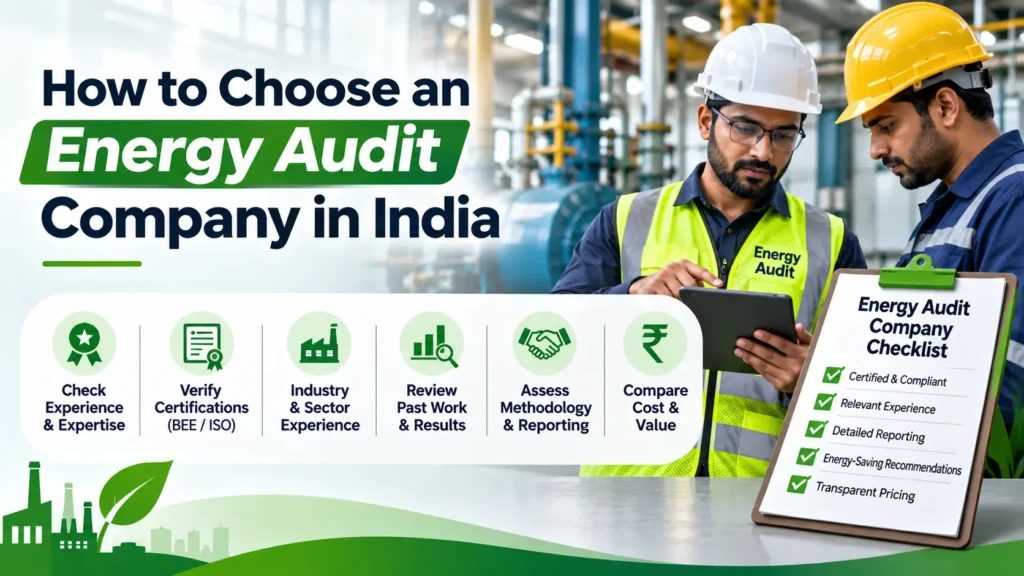
Hiring an energy auditor looks easy until you start collecting quotes. Every company says it is BEE certified. Reports look similar on paper. Prices and scopes don’t match, so you can’t tell which is the better deal.
This guide is for owners, plant heads and purchase managers who have to make that call. It explains what the BEE labels actually mean, how to check them, what to put in the work order, and how to compare quotes fairly. If you already know what you need, you can go straight to our energy audit services page or contact us with your plant details.
Start With What You Actually Need
The right energy audit company depends on why you are hiring.
Your situation | What to look for |
|---|---|
Your plant is a notified Designated Consumer and the audit is a statutory requirement | An Accredited Energy Auditor on the BEE list |
You want lower power and fuel bills | An experienced auditor who measures with instruments and reports payback for each measure |
A customer, lender or ESG programme asks for an audit | An audit that follows a recognised method and a report that can be shown to third parties |
You have one known problem (compressed air, a furnace, power factor) | A focused, targeted audit rather than a whole-plant study |
You are planning a large capital project | A detailed audit with solid financial analysis |
Be clear about this before you call anyone. It decides what you should pay for.
Certified vs Accredited: What the BEE Labels Mean
This is the part most buyers miss, and many company websites blur it.
Under the Energy Conservation Act, 2001, the Bureau of Energy Efficiency (BEE) certifies energy managers and energy auditors through its national examinations. Accreditation is a further step. BEE keeps a register of Accredited Energy Auditors, and an auditor gets onto it only after a further assessment of their audit experience and reports. BEE also shares the updated list with State Designated Agencies and designated consumers each year.
Why it matters: Designated Consumers have to get their energy audits done by an accredited energy auditor. If your audit is statutory, “BEE certified” on its own is not enough. For a voluntary audit to save money, you have more room to choose, and experience, method and instruments matter most.
Phrases like “BEE approved” and “BEE empanelled” appear on many sites. Ask what exactly they mean. Empanelment, for example, is a separate arrangement for particular BEE programmes.
How to check: ask the company for the name and accreditation number of its Accredited Energy Auditor, then confirm it with BEE. Do the same for the person who will actually lead your audit.
What a Good Energy Audit Company Should Offer
| What to Check | Why It Matters |
|---|---|
| Credentials of the Lead Auditor | Tells you who is qualified to sign the report, and for which type of audit. |
| Instruments and How They Are Used | Measured data beats estimates. Ask which instruments are used and for how long. |
| Experience in Your Kind of Plant | A foundry has different losses from a textile mill. |
| Independence | You want recommendations based on your plant, not on what someone sells. |
| Quality of the Report | It should show measured readings, savings, cost, and payback for every measure. |
| Support After the Report | A report that never gets implemented saves nothing. |
| References | Real clients you can call. |
| Communication | Clear answers before you sign are a good sign of clear reporting afterwards. |
Questions to Ask Before You Sign
- Who will lead the audit, and what are their credentials?
- Can I see the accreditation number, if my audit is statutory?
- Which systems and areas will you cover, and which are left out?
- Which instruments will you use, and for how long will you log?
- How many days will your team be on site?
- Will the savings be based on measurements or on benchmarks?
- Can I see a sample report, with client details removed?
- Does the fee include payback and investment estimates for each measure?
- What happens after the report: do you help with implementation?
- Do you sell or install any of the equipment you might recommend?
- Can I speak to two clients in a similar industry?
What to Put in the Scope of Work
A clear work order protects both sides. Use this as a starting list.
Item | What to write down |
|---|---|
Purpose | Statutory, cost saving, customer requirement or planned project |
Boundary | Whole plant or particular sections, and whether captive generation, effluent plant and remote pump houses are in |
Audit level | Walk-through, detailed or investment-grade |
Systems | Electrical, motors, compressed air, furnaces and boilers, cooling, lighting, others |
Instruments and logging | Which instruments, and the minimum logging period |
Site visits | Number and expected duration |
What you provide | Bills, records, drawings, access, a coordinator |
Deliverables | The report contents, a management presentation, and any raw data |
Timeline | When each stage is due |
Confidentiality | An NDA covering your process and cost data |
Exclusions | Anything not included, such as implementation or statutory filing |
Payment | Milestones tied to deliverables |
After the report | Whether Q&A or follow-up visits are included |
Red Flags to Watch For
- A vague scope. “Energy audit” with no list of systems or deliverables could mean anything.
- No instruments. If the findings will rest on benchmarks, expect a generic report.
- A quote far below the others with no explanation of what has been left out.
- No sample report and no references.
- Credentials that are hard to verify.
- The audit is a gift from an equipment seller. The recommendations may lean toward their products.
- No payback figures. A report that doesn’t tell you what each measure costs and returns is hard to act on.
How to Compare Quotes Fairly
Put the quotes side by side and score each one on the same points. A simple table works.
Company A | Company B | Company C | |
|---|---|---|---|
Lead auditor and credentials | |||
Audit level | |||
Systems covered | |||
Instruments and logging time | |||
Days on site | |||
Measured data or benchmarks | |||
Report contents | |||
Payback for each measure | |||
Support after the report | |||
Fee and what it includes |
If two quotes differ widely, look at the scope before the price. The difference usually sits in instruments, days on site or what the report contains.
Energy Audit Services Near You: Where We Work
We are based in Rajkot and work with plants across India. If you are looking for an energy audit company in your state, these pages cover our work there:
- Gujarat: energy audit company in Gujarat, covering Rajkot, Ahmedabad, Gandhidham and Bhavnagar.
- Maharashtra: energy audit services in Maharashtra.
- Rajasthan: energy audit in Rajasthan.
- Uttar Pradesh: energy audit services in Uttar Pradesh.
- Delhi NCR: energy audit services in Delhi NCR, including Gurgaon, Noida, Faridabad and Manesar.
- Karnataka: energy audit in Karnataka.
- Telangana: energy audit services in Telangana.
- Tamil Nadu: energy audit in Tamil Nadu.
You can also see our energy audit services across India overview. If your plant is elsewhere, get in touch and we will tell you what is possible.
Why Plants Choose Optimus Energy Services
Optimus Energy Services is led by Vivek Jainath Sharma, a BEE Certified Energy Auditor and Chartered Engineer, with 13+ years of experience and 200+ audits across forging, foundry, chemical, FMCG and other manufacturing plants. We have also worked on energy efficiency projects linked to SIDBI, World Bank, UNIDO and SDC. You can see our certifications and our company profile.
Our approach is simple: site inspection, data collection, energy analysis, an audit report with ROI insights, and implementation guidance. Alongside the full audit, we offer focused services you can buy on their own: thermal imaging and electrical safety audits, flue gas analysis and compressed air leak detection. After the report, our implementation support helps you act on it, and our energy efficiency training programs help your team keep the savings. Our audits typically aim to reduce power and fuel bills by 10–30%, though results depend on the plant and what gets implemented.
If your audit is a statutory requirement for a Designated Consumer, check the accreditation requirement first and tell us. We will tell you plainly whether we are the right fit.
Conclusion
Choosing an energy audit company comes down to a few checks. Know why you are hiring. Confirm the credentials. Insist on measurement, a clear scope, and a report with payback for each measure. Then compare quotes on what they include, not only on what they cost.
If you want a quote built around your plant, talk to Optimus Energy Services with your location, equipment and goals, or call +91 98503 66248.
Frequently Asked Questions
How do I choose an energy audit company in India?
Decide why you need the audit, check the lead auditor’s credentials, ask about instruments and days on site, read a sample report, and compare quotes on scope rather than price alone.
What is the difference between a certified and an accredited energy auditor?
Certification comes from passing BEE’s national examinations. Accreditation is a further step, with an assessment of audit experience and reports, and puts the auditor on BEE’s register. Designated Consumers must use an accredited energy auditor for their statutory audits.
How can I check whether an energy auditor is BEE accredited?
Ask for the accreditation number and confirm it with BEE. BEE keeps a register of accredited energy auditors and shares the list with State Designated Agencies and designated consumers.
What should an energy audit report include?
A one-page summary for management, your energy baseline, measured findings system by system, each measure with savings, cost and payback, a prioritised roadmap, and appendices with the raw data.
Should the energy audit company also supply the equipment?
It is worth asking directly. Some firms do both well, but you should know whether the recommendations could be influenced by what they sell.
Do you work in my state?
We work across India. See the state pages above, or contact us with your plant location.
What should I send to get a quote?
Twelve months of electricity bills, fuel records, a list of major equipment, shift patterns, the single line diagram if you have one, and the reason for the audit.